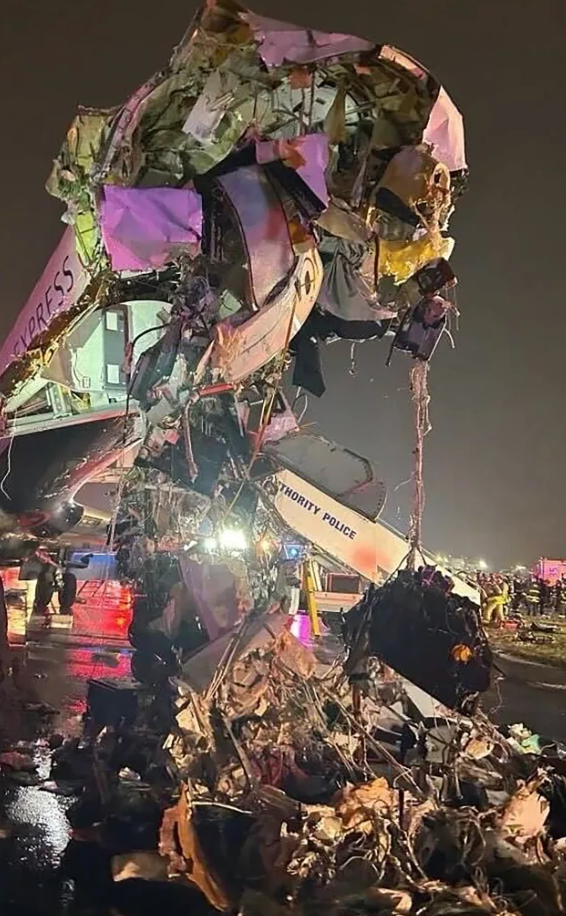
Air travel has always been a headache, but lately, the experience has shifted from inconvenient to existential. While the horrific collision between an Air Canada Express jet and a maintenance truck at LaGuardia was a little while ago, the figurative smoke from that tarmac has yet to clear. As reported by CNN, the March 22, 2026, incident involved a CRJ900 that “collided with a fire truck on Runway 4,” the incident serves as a grim comparison to the concerns that were raised in our May 2025 edition.
A year ago,Giana Nevarez Tevere explored how the “illusion of exposure” on social media was making flying seem more dangerous than it statistically was. She interviewed students like Sydaili Dottin and Nathalie Romero, who noted that seeing “planes exploding” on instagram created a narrative of constant disaster. But in 2026, the narrative has shifted. What was once an “illusion” of danger has been exacerbated by the very real systemic decay. According to audio recordings from the LaGuardia incident, the flight was plagued by issues before it even left the ground; one pilot reported his plane had pushed away from the terminal but had to head back “because of a problem with its de-icing system and a ‘weird’ odor onboard the aircraft.”
The presence of the truck on an active runway has raised many questions regarding ground safety and protocols. Investigation reports indicate that the truck was authorized to be on the tarmac for a routine inspection of the runway lighting system, a task usually performed during gaps in flight schedules. However, a catastrophic breakdown in communication occurred when the vehicle crossed into the path of the aircraft. Driving through an active high traffic tarmac during active operations highlights the small margin for error that exists when ground maintenance and flight schedules overlap under high pressure conditions.
The LaGuardia disaster wasn’t just a freak accident caught on a phone; it was a symptom of a system under siege, where communication and safety protocols are failing in real time. Audio reveals that just seconds after a controller gave permission for the truck to proceed, they seemed to reverse course, emphatically screaming “Stop, stop, stop, stop, stop, Truck One, stop, stop stop!” For those on board the experience was weird. One anonymous passenger told CNN “we hit a very rough landing. It almost felt like the plane jolted. And after that, you hear the pilot try to brake, and it was like a grinding noise…After that, it was a huge, just, boom. And we all just jolted out of our seats.”
The crisis has reached a breaking point with the current partial government shutdown. As TSA agents are forced to work without pay, leading to the massive stagging shortages Tevere predicted last year, the administration has proposed a “solution,” filling the terminals with ICE agents to fill the gaps.
This change has transformed airports from travel hubs into high tension enforcement zones. The presence of ICE at gates, the very agency Billie Eilish famously rebuked at the Grammys, has added a new layer of fear. For many travelers, the anxiety isn’t just about a mechanical failure or a runway crash, it’s about weaponizing the airport itself.
Today, documentation of these events, like on social media, is confirming what many are starting to feel. Between budget cut induced crashes, and the shadow of ICE at the gate, the airport is no longer a place of departure, but a place of dread.
To understand how the youth are processing this political surveillance and the crashes, I spoke with some students who are witnessing these changes. Their responses suggest that while the fear of a crash is manageable, the fear of the airport environment itself is growing.
Reya Conte, a high schooler in LA, believes the mechanical risk of flying remains a reality. “Flying on a plane always has risks,” she noted. “Accidents can always happen, so I don’t think there’s more of a risk than there ever was.” However she does think that ICE in airports is dangerous. “Getting on a plane is another story. I think it is genuinely more dangerous to go to an airport with ICE surveilling them now. Its not accidents in the air that are a danger; its people who are there to possibly, intentionally hurt you.”
Zachary Massim, a student at Stuyvesant High School, shared the idea that while the content is scary, it usually doesn’t stop the world from moving. When asked if videos of near misses, and crashes changed his plans to travel, he said “No, it doesn’t. It is scary to see the video sometimes, but it’s never actually changed my family’s plans to travel.”
Another student from Bard High School Early College Queens added that this climate has shifted the focus from “what might go wrong” with the plane to “who is watching” at the gate. For this generation, the danger of the airport is not just about the pilot or if the Air Traffic Controllers mess up, its about a political system that feels increasingly hostile to the travelers passing through.