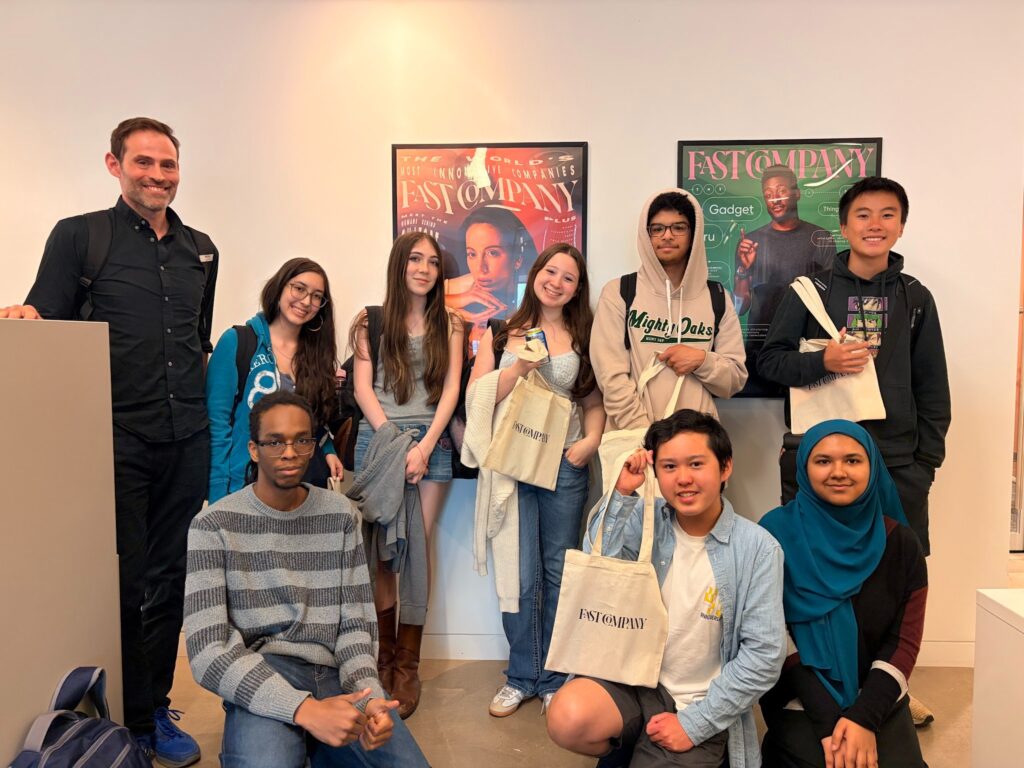
This month, BQ Broadside visited the Fast Company Headquarters At 7 World Trade Center to learn about how a well-acclaimed magazine stays afloat in today’s society, especially with the interference of AI in Journalism.
On our visit, we met Amy Farley, the Executive Editor of Fast Company, who talked about how Fast Company and what it is. She explained that Fast Company is a business focused journalism publication that publishes editions quarterly, with each edition coming out each season. Fast Company discusses major and minor topics in the business world and reports on them through media and through journalism. Official Covers for Fast Company’s latest edition, “The World’s 50 Most Innovative Companies”. In order: Anjali Sad, CEO of Tubi, Steve Huffman, CEO of Reddit, Alex Cooper, Unwell founder and “Call Her Daddy” podcaster, Ryan Coogler, Director of “Sinners”, and founder of Proximity Media, and Sundar Pichai, CEO of Google. Photo Credit Curran Kim.
Farley also spoke about AI’s interference in the future of journalism and explained that, “AI is good at imitating the way a lot of journalists were taught to write, so we have to adapt. Having originality and voice in your writing is even more of a priority”. She explained that even though journalists like herself use em-dashes, it’s considered “AI” writing, they’re not ceding it, since journalists were using it first. She also talked about how, in the 21st century where attention spans are shrinking, newspapers have to use captivating methods in order to maintain a strong following.
We then visited the Photography Department, where we were able to see Fast Company shooting photos for their new edition; titled, “20 AI Innovators”, which highlighted 20 entrepreneurs that were using AI for unexpected and innovative endeavors. The Photography Department explained that they promote and spread their editions through many different ways, such as podcasts with the subjects of their articles. They explained that they’ve interviewed many different CEOs and public figures to post on Instagram to gain attention for upcoming editions.Finally, we chatted with the Social Media and Marketing Department, where they explained how they used Instagram to help gain attention for their upcoming editions. They explained that they had to have engaging and powerful content that would grab the attention of watchers and keep them interested. They showed us some of their content, and explained how they used popular public figures in the media that would stop most people from scrolling, but made sure it was still relevant to their agenda. For example, Alex Cooper from “Call Her Daddy”, who is a very popular celebrity in modern media, had a video for Fast Company, but instead of talking about her podcast like most would expect, she talked about her business Unwell, which was relevant to Fast Company’s agenda. They then offered tips on how to make posts go viral when you have a large following. They also filmed a video where they gave us cards in “business language”, and asked for us to decipher them into Gen Z slang, and asked us how we felt about that kind of language and how it sort of affects how we speak in today’s terms and how slang affects modern language.
A huge thank you to Fast Company for inviting us into their headquarters and sharing their insight on the Future of Journalism. Thank you to Amy Farley for being our incredible tour guide and offering incredible advice for us future journalists. Thank you to the Photography Department Sandra Riaño and Jeanne Graves. Thank you to the Social Media and Marketing Department Tania Rahman and Isa Luzarraga for giving us advice on boosting our social media impact. Thank you to KC Ifeanyi and Isa Luzarraga for starring in our Broadside March Edition Promo Video and being so kind to us. And of course, a thank you to Professor Michael Woodsworth and President John Dean for taking us on this incredible trip.