Most of us probably aren’t refreshing the Nobel Prize website every October, waiting to find out who won. But this year’s winners have been working on discoveries that sound like something out of a sci-fi movie. Scientists are using light to control brain cells, detecting mysterious particles beneath Antarctic ice, and investigating how tiny differences between molecules can change the way chemical reactions work. The 2026 Nobel Prizes recognize researchers whose work helps explain everything from the human brain to the entire universe, and some of these discoveries could eventually affect our everyday lives.
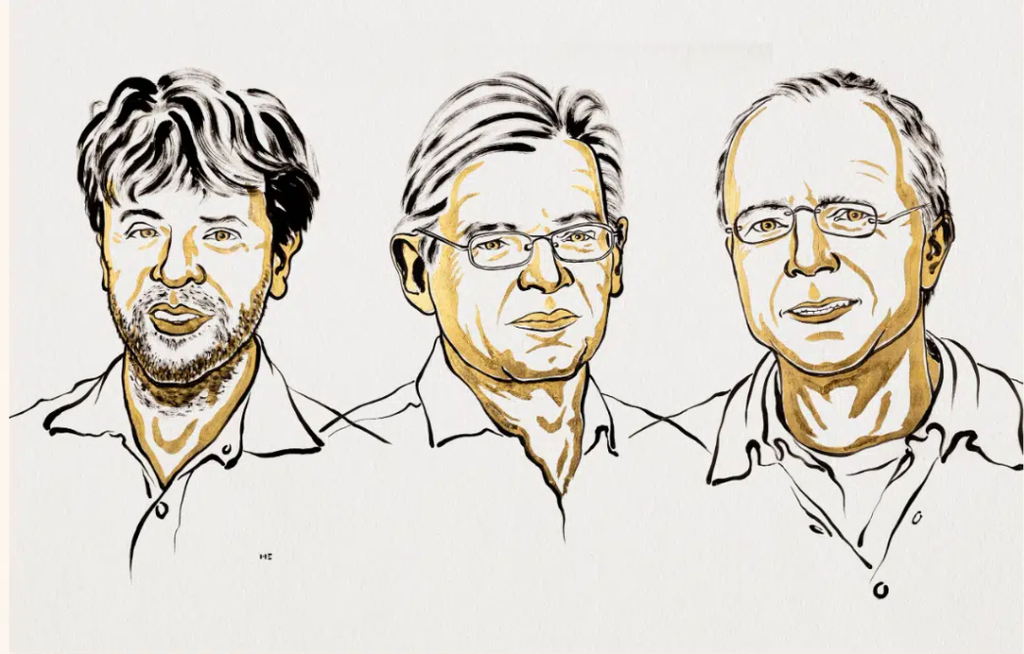
Imagine being able to switch certain brain cells on and off using light. That is essentially the idea behind optogenetics, a technique developed through research by Karl Deisseroth, Peter Hegemann and Georg Nagel. Their work uses light-sensitive proteins, originally studied in organisms such as algae, to help researchers control and investigate the activity of individual nerve cells. This gives scientists a better way to study how the brain works, from movement to memory.“Optogenetics provides opportunities for mapping the brain in a way that we could once only dream of,” says Per Svenningsson, Chair of the Nobel Committee for Physiology or Medicine. The research could eventually contribute to new treatments for neurological conditions, although many potential applications are still being investigated. A BHSEC senior taking neurobiology this semester says that “Learning about this nobel prize makes the stuff we learn in class feel much more real.”
While the medicine laureates are investigating the brain, physics winner Francis Halzen has been studying particles from space. He received the 2026 Nobel Prize in Physics for his contributions to the IceCube Neutrino Observatory and the discovery of high-energy neutrinos from astrophysical sources. Neutrinos are tiny particles that rarely interact with matter, allowing them to travel enormous distances through the universe. That also makes them extremely difficult to detect. IceCube addresses this problem using thousands of sensors embedded deep in Antarctic ice. When a neutrino interacts with the ice, it can produce a faint flash of light that the sensors detect. Mark Pearce, Chair of the Nobel Committee for Physics praises this fascinating technique, saying “We have new knowledge about the universe.”
Chemistry also received its own unusual recognition. Henri B. Kagan and Kenso Soai won the 2026 Nobel Prize in Chemistry for their work on asymmetric chemical reactions and autocatalysis. Some molecules exist in two forms that are mirror images of each other, like a left hand and a right hand. Although the forms may look almost identical, they can behave differently in chemical reactions and biological systems. Producing one form preferentially over the other is therefore an important challenge in chemistry. The Nobel announcements also recognized achievements outside the sciences. Canadian writer Anne Carson received the Literature Prize for her inventive writing, while Navi Pillay was awarded the Peace Prize for her work promoting peace and international law. Economists Robert E. Hall and Michael Woodford received the Economics Prize for research that has helped explain economic fluctuations and inform monetary policy. Each award highlights a different way that research, writing and public service can shape how we understand the world.
For BHSEC students, the awards also offer a reminder that discoveries made in specialized laboratories are connected to the subjects we study in class. We hear about scientific breakthroughs all the time, but it is easy to overlook the years of curiosity and experimentation behind them. After all, you don’t have to be a Nobel Prize winner to appreciate how much there is left to discover.