“[Trump] awakened a lot of people to the issues we’ve been raising for years. He’s the best thing that’s happened to us.” (Reuters) Those are the words of Henry Stout, a leader of the white supremacist organization Aryan Freedom Network (AFN). AFN is one of the fastest growing organizations of its kind, with over 1,500 members across 41 states. However, AFN isn’t an exception. The alt-right community as a whole has experienced an increase of recruitment and activity since Trump’s second term began. This is deeply rooted in historical actions made by his administration, including his provocative immigration rhetoric and his “subtle” support for the movement.
Charlottesville, Virginia, now a relatively serene city, was once the place of a violent clash. In August of 2017, hundreds of white supremacists, neo-Nazis, and Ku Klux Klan members took to the streets of Charlottesville to protest the decision to remove a statue of Confederate general Robert E. Lee, in a rally called “Unite the Right.”
The rioters came armed; they carried firearms and more primitive weaponry such as maces, poles, and clubs, and crowd-dispersing substances like tear gas and pepper spray. On top of that they bore insensitive insignias including swastikas, Confederate flags, and Gadsden flags, which say “Dont Tread on Me”, symbolizing the group’s rejection of the city council’s decision. They were very clearly looking for a fight, and a fight they got.
On August 12, the day after they gathered at the University of Virginia, alt-right members began gathering at the statue of Robert E. Lee. Two hours after the initial gathering, physical conflicts broke out between them and counter protestors. During this time the white supremacists were chanting antisemetic and racist statements, such as “Jews will not replace us,” and “white lives matter,” alongside other neo-Nazi and neo-Confederate slogans.
The Charlottesville Police Department, only around 120 officers strong, largely failed to prevent the violence, and the event was declared unlawful. 20 minutes after that, then Governor of Virginia Terry McAuliffe (D) declared a state of emergency and deployed the Virginia State Police (VSP). Less than 3 hours later, James Alex Fields Jr., a white supremacist, deliberately plowed his vehicle into a crowd of counter protestors, hospitalizing 19 and killing Heather Heyer. Hours after that a VSP helicopter crashed while responding to Charlottesville, killing two police officers.
Two hours after the murder of Heather, Trump addressed the nation. He stated that there were “some very fine people” on both sides. He also expressed sympathy for the cause for which literal neo-Nazis and white supremacists gathered to support: protesting the removal of the Robert E. Lee statue.
This was a very insensitive response. By him saying that there were good people on both sides, he’s purposely neglecting the fact that on one side there were domestic terrorists marching around a university town carrying guns, swastikas, and chanting antisemetic and racist slogans, while on the other side there were anti-racists trying to defend their homes. Even if Trump didn’t exactly say that he supported the white supremacists, the fact that he failed to properly condemn them gives the radical right enough confidence in Trump’s support where they’re more comfortable in speaking out.
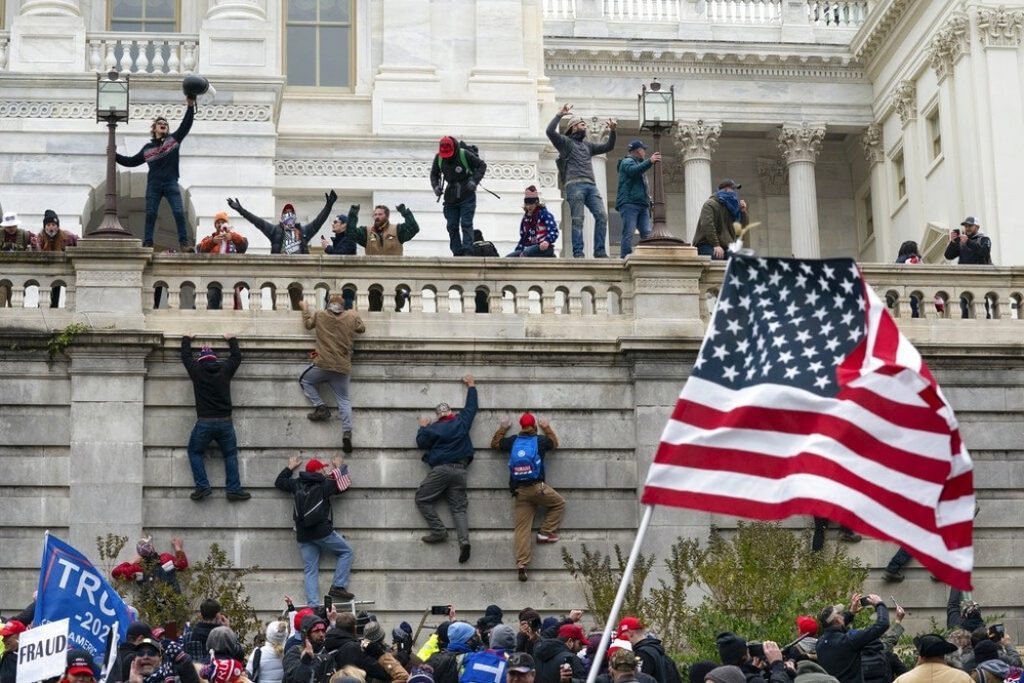
His support was made even more obvious after January 6, 2021. Every four years, on January 6, Congress meets in a joint session to officially count and certify the Electoral College votes from the presidential election. 2021, however, was different. After Joe Biden won the 2020 election, Trump characterized the outcome to be the result of fraud, claiming that he truly won the election and it was rigged. Because of this belief, during Trump’s speech at the Ellipse, he repeated the same lies about the election that he had said before. On top of that, in a legally controversial statement, he publicly pressured Mike Pence to reject the results and refuse to carry out the certification process.
Right before the end of the speech, members of the Proud Boys, a far-right white supremacist militant organization, overran the first United States Capitol Police barrier at the Capitol building. 10 minutes after Trump calls for his supporters to march on the Capitol.
“We fight like hell. And if you don’t fight like hell, you’re not going to have a country anymore,” (CNN) he stated in his speech. This quote has terrifying implications. To not only tell people to march to the Capitol, but also tell them to “fight like hell,” would make most assume that you’re telling people to fight like hell at the Capitol. Without any clarification, this would incite violence. Evidently, it did.
At 2:38 PM, over an hour after the initial breach, Trump finally responds to the riot by saying that the insurrectionists should remain peaceful and telling them to “support our Capitol Police and Law Enforcement.” It’s important to note that he didn’t tell them to leave the Capitol building. By this time, the House has gone into recess, and Pence and his family have been evacuated by the Secret Service.
At 2:44 PM, Ashli Babbitt, a pro-Trump rioter and Air Force veteran, is fatally shot by a U.S. Capitol Police Officer while attempting to breach the Speaker’s Lobby during evacuations. Brad Parscale, Trump’s former campaign manager, condemns the event through a text chain between him and the campaign advisor. He directly blames Trump for this and tells her that Trump’s rhetoric killed someone before expressing his guilt for helping him achieve this.
While Trump’s actions during the January 6 insurrection gave confidence that he would not directly condemn actions by white supremacists and neo-Nazis, it’s what after that is even more concerning. On January 20, 2025, Trump signed Proclamation 10887, a declaration which pardoned over 1,500 convicted January 6 participants, including the former leader of the Proud Boys. Then, in April of 2026, the U.S. Department of Justice (DOJ) filed motions in federal court to erase the criminal records of far-right extremist group leaders who didn’t already receive a full pardon.
These actions have supportive implications for the radical right, especially for some very controversial people. Of the insurrectionists that Trump pardoned, many were convicted of violent charges, mostly for violence on U.S. Capitol Police officers. Additionally, he pardoned Proud Boys and Oath Keepers members who were involved in the January 6 insurrection. He directly supported groups who at that time were some of the frontmen of the white supremacist cause, proving that if something like this happened again while Trump is president, then radical right groups could be safe from punishment.
In April of 2026, Trump’s FBI Director, Kash Patel, reassigned jobs within the FBI to focus less on far-right extremist groups, including those with neo-Nazi and neo-fascist roots. According to The Guardian, Patel “eviscerated parts of the bureau tasked with investigating rightwing extremists that are considered the most dangerous domestic security threat facing the US today.”
This reallocation of resources directly shows Trump’s true agenda when regarding the alt-right movement: to defend his greatest supporters. It’s no surprise that the majority of neo-Confederates, neo-Nazis, neo-fascists, and white supremacists have voted for Trump or vocally support him. If Trump kept investigating these groups, not only could he gradually lose a loud minority of his advocates, he could also accidentally reveal very incriminating material, which would make both him and the movement look bad. According to Reuters, many on the far right now believe “that federal investigations into white nationalists are no longer a priority.”
While both the Charlottesville Unite the Right rally and January 6 happened years ago, connections can be made between them and the modern day sociopolitical landscape. Because Trump has historically failed to properly condemn violent actions taken by those in the alt-right movement, including neo-Nazis and white supremacists, it made these modern day organizations more comfortable to increase activity by hosting more marches, rallies, and potentially more violent alternatives. According to Reuters, “Several trends have converged since Trump’s re-election,” all pointing to the conclusion that Trump’s rhetoric has led to the increase of recruitment and a large growth within white supremacy.
What can you expect in the near future? On social media, you can expect to see more white supremacy recruitment videos, whether it’s subtle, through the means of dog whistles, or more obvious. You can also expect to see more marches, like the one hosted by far-right political activist Jake Lang where he and around 100 other white supremacists marched to the World Trade Center on the 25th Anniversary of 9/11. Finally, you can expect to hear less about federal investigations and prosecutions in the alt-right world, especially from previously active agencies such as the FBI.
When asked about a potential solution, anthropologist and professor at Bard High School Early College Queens Dr. Joshua Marshack said that the reason people are joining these organizations isn’t necessarily due to social issues, but rather materialistic issues: gas prices, housing costs, medical costs, etc. Many people flock to the alt-right movement because there isn’t an anti-government movement of such reach on the left. If one were formed, Dr. Marshack implied that there would be a drastic decrease of recruitment into the alt-right.