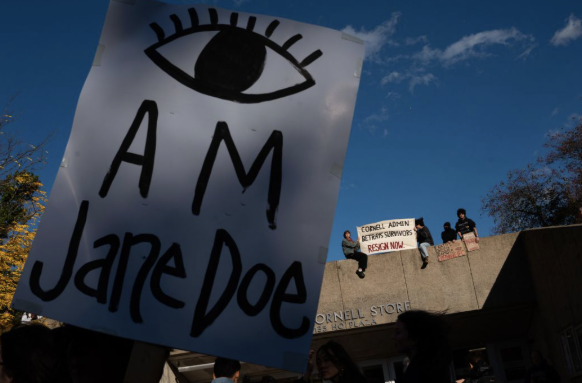
The enablement of sexual assault on College Campuses Cornell, a prestigious Ivy League university known for its “excellence in education, research and public engagement,” as its website describes, has added a layer to their reputation. On October 19, 2024, a Cornell student identified as Jane Doe was raped by seven members of the Cornell Chi Phi fraternity. Already heavily intoxicated upon arrival at the Chi Phi house, and pressured into taking more substances, Jane Doe was unable to give consent to any sexual acts done. During the seven hour period in which she was sexually assaulted, there were incriminating messages in the Chi Phi Snapchat group chat. Screenshots of this group chat have been made public, and these show members of the fraternity encouraging and inviting everyone to join in. Jane Doe was assaulted by seven men: Matthew Ingalls, Jonathan Newell, Winston Lee, Gillio Lopes, Diego Sarabia, Scott Norris, and Scott Kretzschmar. There were also 57 men in the Chi Phi group chat.
In the weeks following the night of October 19, Jane Doe opted to go through the Title IX process. The university conducted a formal investigation of the incident. Title IX is a federal civil rights law prohibiting sex based discrimination in any education program receiving funding from the federal government. In her statement, Jane Doe describes being “pretty incapacitated” and “horrified” when more men entered the room she was in. She also describes being physically hit, and she collected photos of bruises on her body as evidence. After months, the investigation concluded with the expulsion of two of the seven students and the closure of the Chi Phi chapter. The other students involved were offered the chance to mitigate their conduct by submitting essays. The two students expelled are two of five people expelled from the school between 2019 and 2024 for sexual misconduct. In that time period 171 cases were brought to the school for investigation.
Now, two years on, Jane Doe has filed a lawsuit in New York County Court concerning allegations of the gang rape. She is suing Cornell University, Chi Phi fraternity organizations, the former president of the Chi Phi chapter, and others involved in that night. The Cornell student newspaper, the Cornell Daily Sun, is the primary source responsible for bringing this to public attention. In a published editorial titled “Cornell Won’t, We Will,” the editorial board called for accountability by the University for not only its handling of Jane Doe’s case, but also of the widespread issue of sexual assault on campus, writing, “Cornell has failed to protect its students. Cornell has failed to address the growing issue of sexual assault on campus with its pathetic task force. Cornell has failed the student allegedly raped by those seven men at Chi Phi in October 2024.”
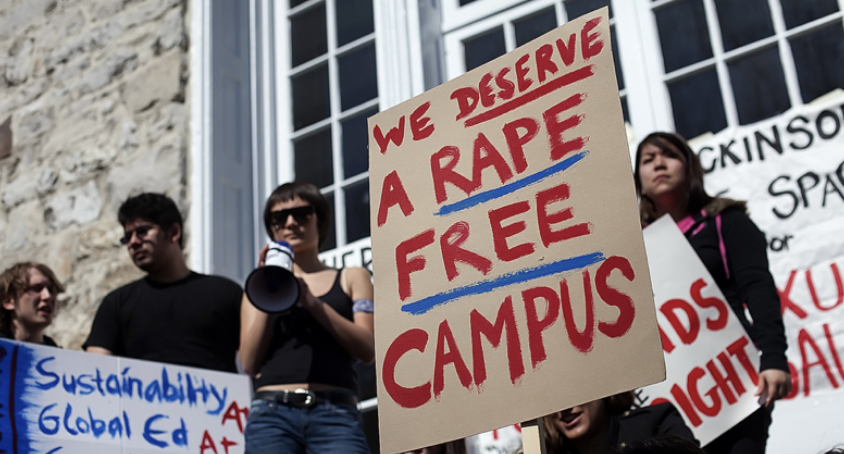
This particular sexual assault case receiving so much attention from the public has brought forth a much larger discussion concerning sexual assault on college campuses, specifically large ones, and the lack of consequences when reported. Enforcement of Title IX, which “prohibits sex-based discrimination in education,” has shown a consistent history of resulting in lax consequences for students accused of sexual assault. Recent surveys show that about 1 in 5 undergraduate students at Cornell say they’ve experienced at least one incident of sexual assault or violence. The majority are never reported. At more than a third of large schools, rapes and sexual assault incidents were reported more than once a month on average. Columbia University Professor Mana Kia notes that “In practice, title IX is used to protect the university, not victims of sexual assault.” Throughout Columbia’s 2014-2015 school year, a student Emma Sulkowicz carried around the mattress she reported she was raped on, even carrying it with her across the stage at graduation. This was to protest the way the university had handled her case and the fact that her rapist, who had also been reported by multiple people, was still on campus. Her senior project, “Carry that Weight,” received nationwide attention and sparked a movement similar to Jane Doe’s Cornell case over 10 years later.
In the year of Sulkowicz’s protest, there was an event held on Columbia campus where the students were taking turns describing what had happened to them and their experience with Columbia’s reporting and judicial process and the fact that they did not get the justice that they were seeking.” As Professor Kia listened in she remembers hearing that, “the students were not expelled; they were usually either suspended for a short period of time and then would reappear on campus or nothing like that happened at all, or they were their schedules were just adjusted so that they wouldn’t have to overlap and various classes like core classes with the people were accusing them of rape and sexual assault.” These handlings of sexual assault follow a pattern across college campuses in the US. But how many times does this movement need to be reignited for real change to happen?