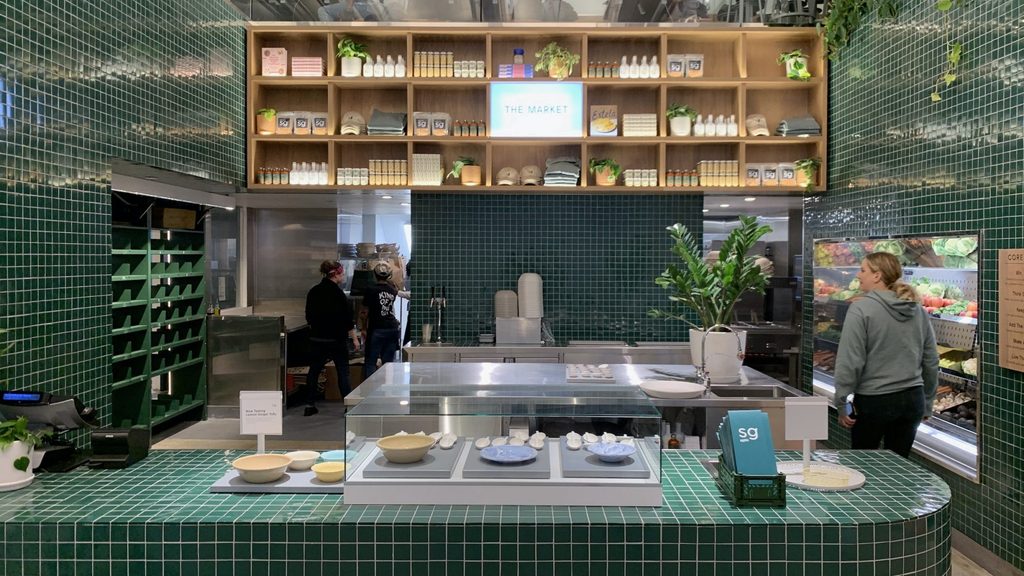
The rise of fast casual food was started by a college student disappointed with the food options in his university. In his own words, “there was an opportunity to have something that was fresh and healthy, but also affordable and fast” he told the Georgetown University Newspaper. The idea of fast, but also healthy food is a relatively new idea. While chains like Panera and Chipotle were already well established by 2006, and Whole Foods had pioneered high end organic groceries, Sweetgreens took a different marketing approach. When they were starting to create a national movement aimed at young health-conscious people, one of their first national ad campaigns says “Follow Your Greens.”
Sweetgreen doesn’t just focus on the fact that it is a salad, it is also about it being organic and that their vegetables are healthier than other vegetables. This idea took the world by storm in the post-pandemic world, where many cooked for themselves and were used to housemade meals. When Sweetgreen was at the peak of its expansion in 2021, Subway was forced to make an “Eat Fresh Refresh” campaign where Stephen Curry and Simone Biles list top ingredients from Subway, along with talking about how fresh the food is, contrary to former ads where they just talked about the ingredients. Although obesity has increased, healthy food restaurants are in style, perhaps due to this.
The second thing that Sweetgreen and its competitors introduced was convenience. During the pandemic, most got used to eating by themselves while scrolling or watching T.V. The culture that this habit formed made the rise of fast-casual restaurants where one could not feel too bad about themselves and eat fairly healthy food, yet still have minimal interaction.
You could place your order before even walking in, pick it up by seeing the name on the receipt, and have your food quickly. All the employees have matching uniforms. Digital kiosks minimize interaction between customers and employees. It feels transactional, as if not to show humans behind the countertop. To an extroverted person, this may feel dystopian, but it is an attractive thing to those who may have social anxiety or just don’t want to see employees giving them their food. This idea is especially appealing to college students, who might want to work at the tables without interruptions.
But recently, Sweetgreen has over-expanded. They have thought that due to the increasingly digital landscape of the world, people would continue to love this easy and fast food. However, another player is starting to expand in the form of ethnic, and mostly Asian fast food.
Most of these takeout places market themselves similar to Sweetgreen; fast, easy and simple but seem to have more of a charm to them. Americans are interested in Japan and Korea more than ever, partly due to Anime and K-Pop. The idea of a place where you can sit down facing a window, but with something that takes your attention more than just a salad bowl is very appealing. As the world becomes more and more interconnected and cross-cultural, food that is American or European inspired seems uninteresting to many.
In addition, many parts of Asia have particularly technologically advanced cultures, meaning that in comparison, Sweetgreen just making things fast and easy isn’t always enough. Just the idea of making things seamless and without employees suddenly isn’t enough. People want touchscreen tablets, and a vibe that encourages work and discourages talking. Particularly near colleges, these kinds of places have taken over. In the café scene, as Starbucks plummets, Luckin coffee where one can only pay with a phone, is taking over. They are having more locations in the U.S. than ever, and rapidly targeting university neighborhoods.
This brings us to today, where the affordability crisis continues, and all large businesses are suffering. Surprisingly, local businesses are starting to thrive for the first time in a while. According to the National Federation of Small Businesses (NFIB) “the Optimism Index for the services industry increased 3.7 points from October to 99.3, matching the Index for all firms” this year.
The success of small businesses contradicts the shift towards a loner culture in the U.S. Customers are rushing to local businesses, perhaps in an act of rebelliousness, proving that they want things to feel authentic. New York City can often be a preview of trends in the rest of the country, and New Yorkers are now going in a counter-futuristic direction.
The Asian food trend isn’t going away anytime soon. Every year, grocery stores add 4.7% Asian foods a year according to CNBC, which is a good indicator that they are doing well. Grocery stores try to have every kind of food, so this proves that people are buying it. Abby, an employee at Butterdose, a coffee, pastry, and creampuff shop in the East Village that features exciting flavors with Matcha, Ube, and Black Sesame quotes that this is good for business. While handing a smiling customer a fresh creampuff she says that she enjoys watching people, “be curious about food that they are not as exposed to.” People really enjoy trying new food.
Both Sweetgreen and Chinese fast food that are trying to enter the U.S., are inherently anti-social. In reaction, people are starting to get out of the house and go to local businesses looking for a community that isn’t cold, but welcomes them. Abby also provides that there is a “sense of community because it is a family owned business.” She says that it is, “better than working in a chain,” something that consumers are picking up on. As the price difference between local businesses and chains diminishes, more people are going to establishments like Butterdose. This mom and pop establishment was once considered a place just for conversation and is now also a place to get work done.
Whether the future is high tech Asian businesses or cute shops is to be determined; but the cultural phenomenon of Sweetgreen is dead.