The White House’s official X (formerly Twitter) account has received widespread criticism after posting several videos on their official Twitter/X account, promoting immigration enforcement actions paired with hit songs by pop stars Sabrina Carpenter and Olivia Rodrigo. Both artists condemned the use of their music, asking for the administration to remove the audio from each video.

The first argument began on December 1, when the White House shared a video Immigration and Customs Enforcement (ICE) officers detaining people while Sabrina Carpenter’s song “Juno” played in the background. Shortly after the video circulated, Carpenter responded directly on X, writing “This video is evil and disgusting. Do not ever involve me or my music to benefit your inhumane agenda.”
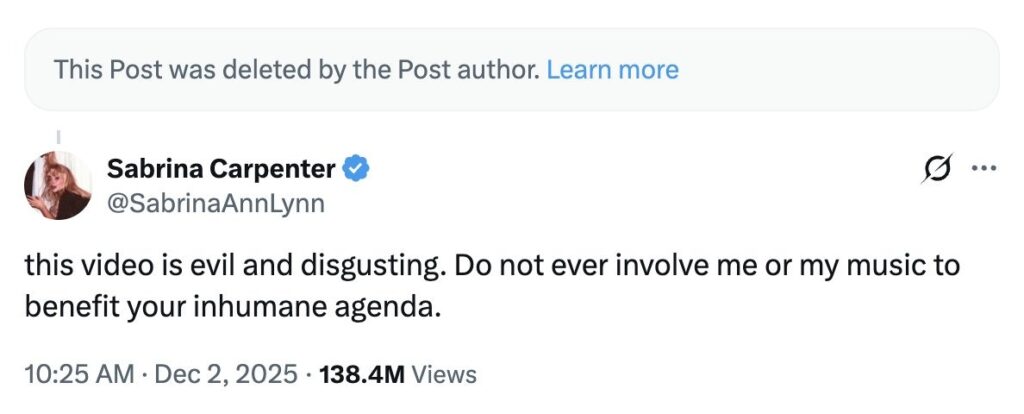
In response to Carpenter’s statement, the White House deleted the audio from the video. However, the controversy surrounding the original post, escalated after White House spokesperson Abigail Jackson publicly responded to Sabrina Carpenter’s backlash. According to ABC news, Jackson wrote in a statement“Here’s a Short n’ Sweet message for Sabrina Carpenter: we won’t apologize for deporting dangerous criminal illegal murderers, rapists, and pedophiles from our country.” Days later when a second post appeared featuring an edited clip of Carpenter from SNL overlaid onto ICE operation footage. It is said that the clip was edited without Carpenter’s participation and again paired her audio with immigration-related messaging.
A different but similar incident occurred earlier, singer Olivia Rodrigo called out and criticized the administration after using her song “All-American Bitch” in a Department of Homeland Security video encouraging undocumented immigrants to self-deport through a government app. Rodrigo went on to critique the usage of her song through a social media post that went viral on social media networks. Rodrigo said: “Don’t ever use my songs to promote your racist, hateful propaganda.”

Her song was then removed shortly after.
These incidents have raised broader concerns about government agencies using trending songs and copyrighted music in their social media posts. Critics argue that pairing viral pop music with serious topics like deportation can trivialize sensitive policy issues and blur the line between public information and entertainment. Additionally, while some platforms allow copyrighted music to be used through built-in audio libraries, artists and rights holders can object when their work is used for political or governmental messaging, leading to takedown requests and legal concerns.
Immigration and media-ethics experts have also pointed out that the White House is held to a different standard than typical social media users, especially when posting content that serves as public policy communication. The Washington Post reported that Carpenter’s team did not give consent for any use of her music, and that the artist’s objection centered on the political messaging being paired with her creative work.
People Magazine reported that after Carpenter’s initial criticism, the White House removed the soundtrack from X “due to copyright concerns” before reposting the video without music. On TikTok, the audio associated with the video was later unavailable, though it remains unclear whether the removal was initiated by the platform or by Carpenter’s team.
Similarly, Rodrigo’s case sparked conversation among fans, lawyers, and digital-rights advocates about the boundaries of music licensing in political communication. The Guardian reported that Rodrigo’s team was not contacted by the White House or the Department of Homeland Security (DHS) before her song was used, and that she only learned about the video through fans who saw the post online. Comparable situations have also occurred with other artists, including SZA, whose music was reportedly used in political or government-related content without prior approval, further fueling concerns about consent and licensing in digital political messaging.
Public reaction to the controversy has also highlighted confusion and frustration around the use of pop music in government messaging. A high school student interviewee said “No I wasn’t aware that they had been using popular gen Z music in their ads.” Another noted, “even other content creators outside of government media get copyrighted issues when using copyrighted music. But also coming from government media I feel that it’s unusual and unserious for what they are promoting.” A third high school interviewee added that using pop music in ICE related content felt inappropriate, saying it was “kind of mocking the situation but also trying to cover the actual seriousness that people might not even realize.”
The administration has not released a full public explanation of how the songs were selected or why they appeared in the videos. However, all posts using copyrighted music have since been edited to remove audio, and no further musical content has been added to ICE-related videos since the backlash.
Ultimately, the incidents represent an ongoing challenge for the government regarding its communication practices on social media. Copyrighted music, viral audio, and images of celebrities are often only a click away, sometimes allowing content to be used in ways the original creators never intended.